
Article: Ella's Birth Story
It started quietly, the way most extraordinary things do.
On 14/6/26, my due date, during the Australia world cup soccer game, I felt a tiny gush in the kitchen while I was making lunch for my husband, Joel and myself. It was small enough that I could have talked myself out of it, but something made me pause. The fluid was clear, nothing like anything I'd noticed throughout my pregnancy, so I called my midwife and we decided to monitor things overnight.
Nothing more came. No confirmation, no pattern, just uncertainty. And then the next day, at almost exactly the same time, it happened again.
I called again and we agreed I should go into hospital to get tested to make sure it wasn't a hind water leak.
Honestly? I was in denial. I walked in completely expecting to be sent home and told it was just an increase in discharge. But the test came back positive. My waters had broken and they had been broken for over 24 hours. The word "induction" entered the room for the first time, and the clock started... the very thing I'd been hoping to avoid by choosing a home birth.
I wasn't ready to go down that road without giving my body a chance to do things on its own terms.
The induction was originally booked for Tuesday June the 16th, but we pushed it back to the next morning to make sure the risk-benefit equation genuinely warranted it. That gave me a window and I used every hour of it.
I did all the oxytocin producing activities - I rested, I lay in darkness, I watched Off Campus (for the fourth time), I walked, I did the exercises, I bounced, rolled and moved through what felt like endless Braxton Hicks. Nothing was shifting into something I could confidently call labour.
On Tuesday afternoon, as a kind of "hail Mary", I went to see a Chinese acupuncturist. She spent over 90 minutes with me, looked me in the eyes at the start of the session and said, “We need to do hard work on your body!” And she meant it - I think the stress of the business in the last few weeks of pregnancy had taken a toll on my mind and body.
I came home that afternoon feeling something different. Little niggles, maybe one every 20 minutes, nothing I would confidently call a contraction, but something I couldn't quite dismiss either. I called my midwife and we talked it through and together we decided to do a stretch and sweep that night as a last resort as the induction was scheduled for the next morning.
My midwife arrived and did the examination / stretch and sweep at 5PM. I was lying there completely expecting her to find that nothing had happened and that my cervix would be long and closed.
She spoke the words and we both stared at each other.
5 centimetres dilated, fully effaced and I had not felt anything I would describe as a "real contraction".
I was 5 centimetres, fully effaced...
I was a midwife and this sentence made no sense to me. How was this even possible? In nearly 20 years of practice, my midwife said she'd never seen anything quite like it either - especially for a first time mum (also known as a primip). We were both in disbelief.
From there, things began to shift, slowly. What I was feeling were now, unmistakably, contractions - coming maybe every ten minutes.
My midwife lived just three minutes away and told me to call her if contractions got stronger, more frequent, or my fore waters broke. The textbook "established labour" four contractions in ten minutes, each lasting 60 seconds didn't apply to me. My body was clearly doing things a little differently.
Thirty minutes passed and my contractions were coming more frequently... nothing I'd call established and nothing I couldn't work through on my own. But my midwife messaged to check in and decided to come back anyway.
I tried the TENS machine. It didn't help. If anything, the distraction pulled me out of the quiet internal space I needed. I took it off and went deeper inward. I found my rhythm in low, slow breathing and a low hum through each wave. Sitting on the toilet and standing in the shower were also my friends.
At some point in the early hours of Wednesday morning (time having become entirely meaningless to me by then) my midwife suggested a rest. She could hear from the other room that my contractions weren't picking up. I lay down with Joel. And some hours later, we decided to do another examination.
I wouldn't normally have this many examinations and my midwife wouldn't normally do them either - but the problem was, my labour wasn't following the textbook pattern.
She mentioned depending on what my body was doing she would either let me rest or get me up and do exercises.
She assessed me and got me up for exercises which I knew in my head meant that I was progressing - she didn't tell me what I was in that moment but I was 8 centimetres.
My body had been labouring quietly, privately, in its own language, while the clock ticked forward and the rest of the world slept. Eight centimetres and I still hadn't felt what most women would call established labour.
We tried acupressure, movement, walking with nipple stimulation (yes and it worked), anything to coax the contractions into a rhythm that could actually carry me through. And something worked, for a moment. But we kept noticing the same pattern: the moment anyone entered the room, my contractions would fizzle. Even with my husband, Joel. Even in my own home, my body was too aware of its audience.
Looking back, I believe I was someone who needed to labour privately, almost secretly, even from the people I loved and trusted most.
Before that became fully clear, something else happened. Walking through the kitchen, I felt a loud pop during a very long and strong contraction. My fore waters broke, followed by me vomiting. Joel was woken up. And my midwife, watching me, understood: if I was 8 centimetres a few hours ago and my waters had just broken, we were likely very close.
I got into the birth pool which is where I wanted to give birth.
But... my contractions fizzled again.
The pool changed the setting. Joel being close changed the setting. Something in me couldn't quite let go. I was having maybe one contraction every ten minutes at this point, which was not going to bring my daughter into the world.
My second midwife, arrived. She brought acupuncture needles, tried to rouse things again. Joel and I were sent to our bedroom alone, nipple stimulation, movement, privacy, a last attempt to let my body remember what it was doing. Joel held me. We tried.
Still only one contraction every six minutes. Maybe fewer.
We had been at this for hours now. I was fully dilated. My daughter was right there. And my body, for reasons that remain genuinely unknown to all of us, would not produce the contractions needed to birth her.
After two to three hours of coached pushing (not something I wanted to do but knew I had to), I knew. As a midwife, I knew before anyone said it out loud. We were pushing uphill. We needed more regular contractions, we needed Syntocinon. I needed to feel that overwhelming urge... We needed the hospital.
There was surprisingly no grief in that moment. I had given this birth everything I had at home. I had prepared, planned, trusted, waited and worked. My home was where I had felt safest and it had held me through almost all of it. But I was not going to birth my daughter at home on 6 minute contractions. That was not the decision of fear. That was the decision of knowledge.
After chatting to my midwives and deciding transferring was the best option, Joel drove us to Box Hill while our midwife followed. I was terrified of birthing in the car but also knew this was an irrational fear as I couldn't birth her in 2-3 hours with infrequent contractions so why would the car change anything!
The majority of the team there were incredible. They did their own examination because, medically, what we were describing made almost no sense.
Fully dilated. Minimal contractions. A first-time mother.
They confirmed it, looked at each other and started the drip.
Box Hill let me labour in the birthing pool with Syntocinon running, which I hadn't expected and was so grateful for. I made sure I faced away from everyone in the room, towards Joel. I knew by now that was how I laboured best, turned inward, away from watching eyes, even in a hospital room full of strangers doing their jobs.
We had music playing softly, and underneath it I could hear other women through the walls, somewhere in transition, somewhere crowning. Those sounds were not unfamiliar to me. I had stood beside countless women making those exact sounds in my years as a midwife, and hearing them now from the other side pulled something up in me, a strange collision of memory and present moment, a little thread of old trauma surfacing alongside everything I was trying to do with my own body.
Joel got emotional hearing it too. I think it hit him in a way he hadn't expected, the rawness of those sounds reaching us through the walls while I sat there working through my own labour.
Facing him meant I had my back to the room, to the monitors, to the moments when my daughters heart rate was taking longer to recover and I could hear the shift in voices behind me, the particular quietness that comes over a room when people start watching numbers more closely. I couldn't see it, but I could hear it in their tone. Joel stayed right in front of me the whole time, and between contractions he gave me head massages, slow and steady, and that small, simple thing helped me stay calm and stay within myself when everything else was getting louder.
I had 3:10 contractions now. The urge to push came, finally, properly. The drip increased slowly until we reached 4:10 contractions - what we were chasing this entire time.
I pushed for about two hours in the water. Ella's heart rate began dipping with the pressure of descent, a little slower to recover each time. The room grew quieter in that particular way rooms do when doctors start making calculations.
The obstetrician came to me and said from behind... if I didn't birth her in the next contraction, they would need to do an episiotomy.
For those of you that know me, I am not naturally a direct person. But in a voice I barely recognised as my own, I said: "I AM NOT HAVING AN EPISIOTOMY."
In that moment I was upset. I got teary. I was exhausted. It pulled me out of my zone at exactly the wrong time, and I felt it. But I also believe, looking back, that it gave me the motivation to push that little bit harder than I thought I had left in me.
And I birthed my daughter in the next three contractions (without an episiotomy)
The feeling of her head being born was intense in a way I don't think I can fully put into words. Once you reach that point, something in your body just takes over, an uncontrolled pushing that you're not really directing anymore, it directs itself. Each stretch felt a little more intense than the last, and I was genuinely fearful of it in the moment. But I kept telling myself the stretch was necessary, that I would meet my daughter soon and that fear and knowing could exist in the same breath.
At one point I reached down and felt her head. I felt hair. And that was the moment it became real, not abstract anymore, not something happening to me, but her, actually there, right at the edge of arriving.
One final push in the water. My daughters head halfway out. With concerns rising over her heart rate, I was told to get out of the water right then. Somehow I did. I stood at the edge of that pool with the pressure and pain and walked slowly over to the bed and leant over it. With one more contraction, gravity took over, my body took over and she was born. Even through the pain, something just comes over you. A maternal instinct. A knowing that in that moment, you simply have to push through, and so you do.
The moment she arrived, everything in me just broke open. Relief first, immediate and total, the kind that floods every cell once you know it's over and she's here, safely. Then exhilaration, this wild disbelief that after everything, the fizzling contractions, the hours fully dilated, the transfer, the drip, the pushing, she was actually here, breathing and real. Overwhelm came right alongside it, my body and mind trying to catch up with what had just happened over those 36 odd hours. And underneath all of it, pure joy. Uncomplicated, enormous joy, the kind that doesn't need anything else explained or understood. She was here and she was well. That was the only thing that mattered in that moment.
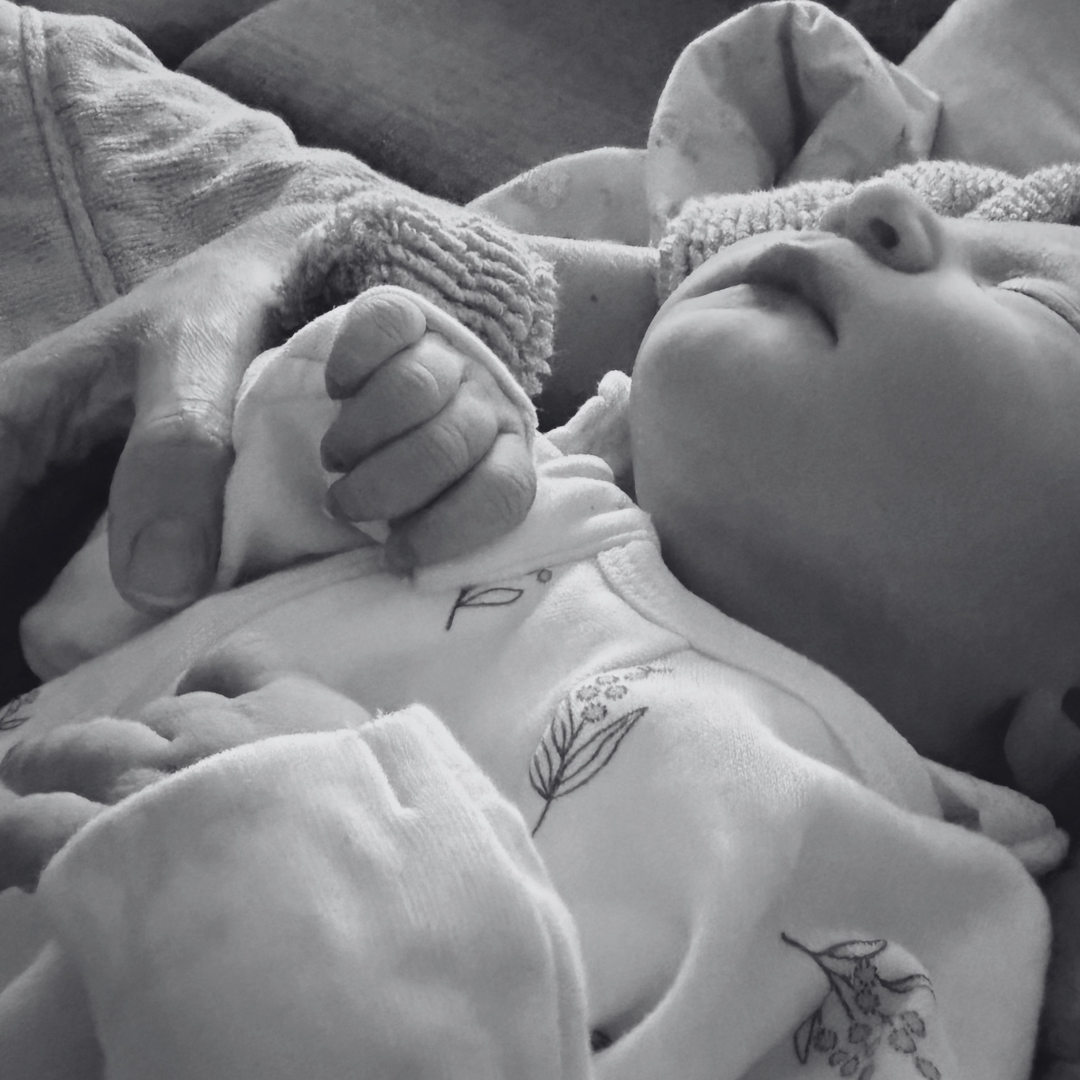
Ella Florence Gilmore arrived earth side at 14:30 on 17/06/26, weighing 3.45 kg
The cord pulsed for twenty minutes. Not the standard three. Twenty minutes, because that was what Ella needed - all that blood completing its transfer, her body receiving every last thing the placenta had to give. We waited. We watched it pulse. We did not rush her. Again, my midwife was in disbelief - it was pulsing for so long that she even asked me to feel it myself. And yes, it was still pulsing.
When it finally stopped and the placenta was delivered, I sat with what had just happened.
A note on pain, for anyone reading this who is hoping for an unmedicated birth.
I didn't have a textbook labour by any means. Mine was unusual in almost every way possible, dilating to 5cm without feeling much at all, contractions fizzling at the wrong moments, chasing contractions with gravity, needing a hospital transfer for being fully dilated with inconsistent contractions. So take what you want from this and leave the rest, because my body clearly does things its own way.
What helped me, was going inwards. Breath work. Low vibration humming through each wave. Swaying. Water. Those were my friends.
Distraction was not.
The TENS machine, the comb, people entering the room, anything trying to pull my attention outward, none of it worked for me. I needed to focus on each contraction individually and make my way through it, not around it.
Counter pressure helped enormously too. And being in the bath while she was crowning was something else entirely, that buoyancy taking the edge off everything at exactly the moment I needed it most.
Gravity was a more complicated relationship. Once labour was properly established, standing or being upright intensified everything, so it became a bit of a love-hate relationship for me, useful, but intense.
Water, on the other hand, was unconditional. Buoyancy, relief, calmness.
If I take one practical thing from this whole experience to pass on, it's that breathing and "groaning" or "humming" carried me more than almost anything else did.
And as for the stretching (crowning) - yes, it's painful, there is no denying that, but it's also manageable with breathing, water and reframing your mindset to know that the stretching is necessary and means you are closer to meeting your baby. Your body knows what to do here, even when it doesn't feel like it. Trusting the process and trusting yourself makes more difference than people expect.
As I sit here and write this blog I am left with so many questions...
Why did I dilate to 5 centimetres without feeling much at all? Why could my body progress to 10 centimetres and remain there for several hours on contractions that came every six to ten minutes? Why did I have to walk to increase the frequency of my contractions? Why did everyone entering the room cause them to fizzle? Was it cortisol overriding oxytocin? A nervous system that simply wouldn't release? Something about me and Ella together that made this labour this particular, specific, unrepeatable shape? What will happen in my next labour?
I don't know. My midwife doesn't know. It sits in a category neither of us has a clean answer for.
What I do know is that I was present for every moment of it. Perhaps more present than was useful, honestly. I was hyper-aware of every person in the room, every shift in atmosphere, every thought passing through the minds of the people around me. I was analysing or perhaps you could say, midwifing myself.
And I know that transferring to hospital was right. I never doubted it and I trusted my midwives completely. I had no fear in that transfer, only certainty. We had done everything we could at home. The home held me for as long as it could. And then hospital did the rest.
Ella Florence Gilmore is perfect and I would do it a million times over to meet this perfect little human we are so in love with.
This is her story. And mine.
About the Author
Caitlin Gilmore: Nurse, Midwife & Nutrition Consultant
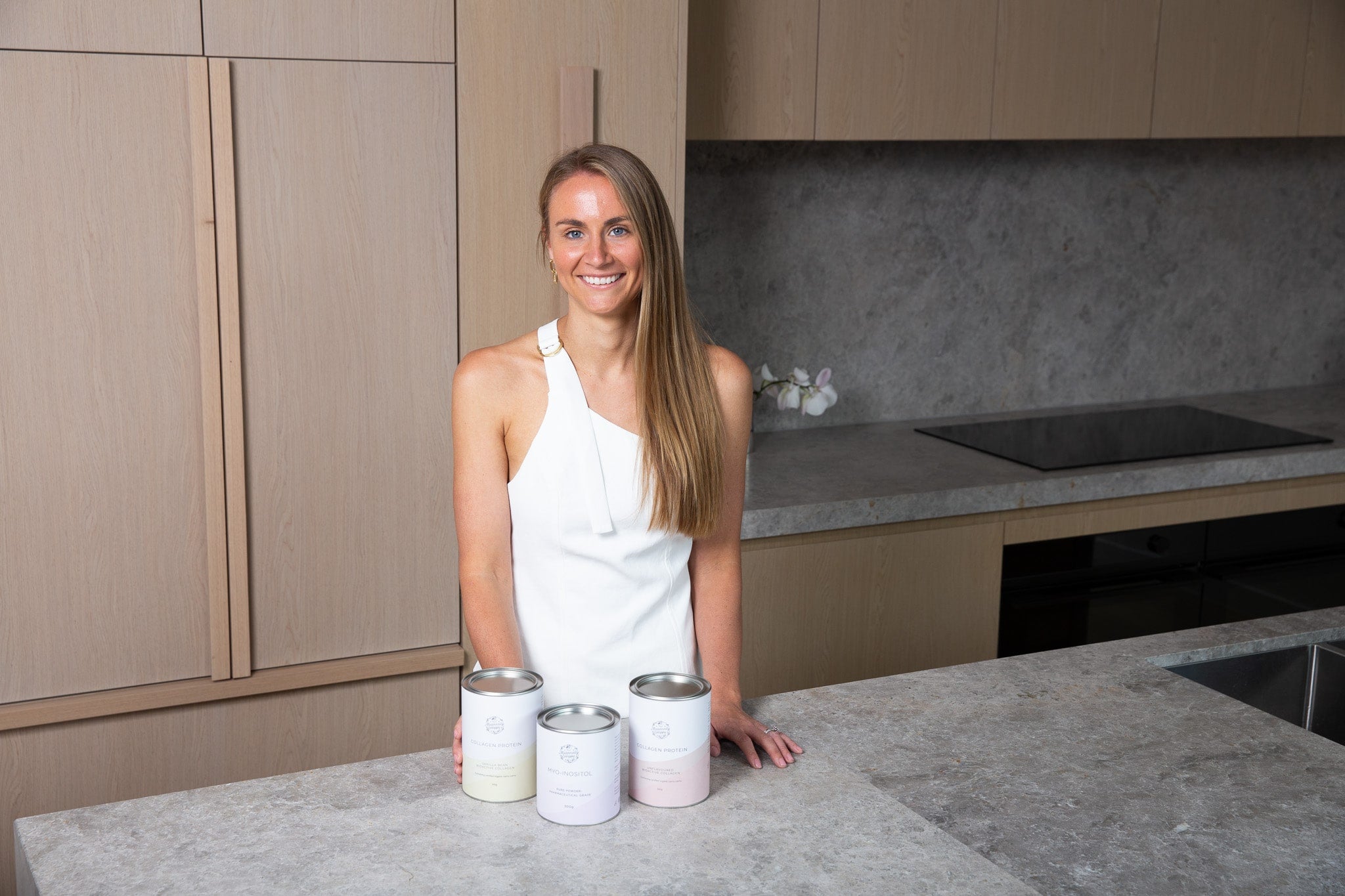
Caitlin is the founder of Maternally Happy, an Australian wellness brand specialising in bioavailable supplements, prenatal vitamins, and evidence-based resources designed to support women from preconception through postpartum.
With qualifications as a Nurse, Midwife, and Nutrition Consultant, Caitlin combines over a decade of clinical experience with nutritional expertise to deliver trustworthy, research-backed advice. Her writing focuses on fertility, pregnancy, postpartum recovery, and hormonal health - helping women cut through the confusion with practical, evidence-based information.
When she’s not formulating practitioner grade supplements or supporting her community, you’ll find her enjoying a chai latte, hiking in nature, or spending time with her family, friends, and two border collies.

What is Lactoferrin? The Iron-Regulating Protein That Changes How Iron Supplementation Works
Most women have never encountered lactoferrin in a supplement before and yet it may be the most important ingredient in the entire formula - the component that separates Iron Matrix from every othe...
Read more
Short, science-backed tips to support fertility, pregnancy, and beyond - plus exclusive promotions